
By Jim Siemens | N.C. Board Certified Family Law Specialist
In thirty years of family law practice, I’ve seen the same pattern play out more times than I can count. Someone decides they want a divorce, they tell their spouse, and then, often within days, documents disappear. Financial records that were sitting on the kitchen counter, account statements that used to be accessible online, or tax returns that can’t be found.
Unfortunately, that’s not paranoia. It happens, and once you’ve announced that your marriage is ending, your access to shared financial information may become much more difficult.
This is why gathering financial documents before you break the news is one of the most important steps you can take to protect yourself.
Gathering documents is not adversarial, and it’s not about winning. Taking this step gives you a strong knowledge base about where you stand financially, so you can enter this process from a position of clarity and make informed decisions about the rest of your life.
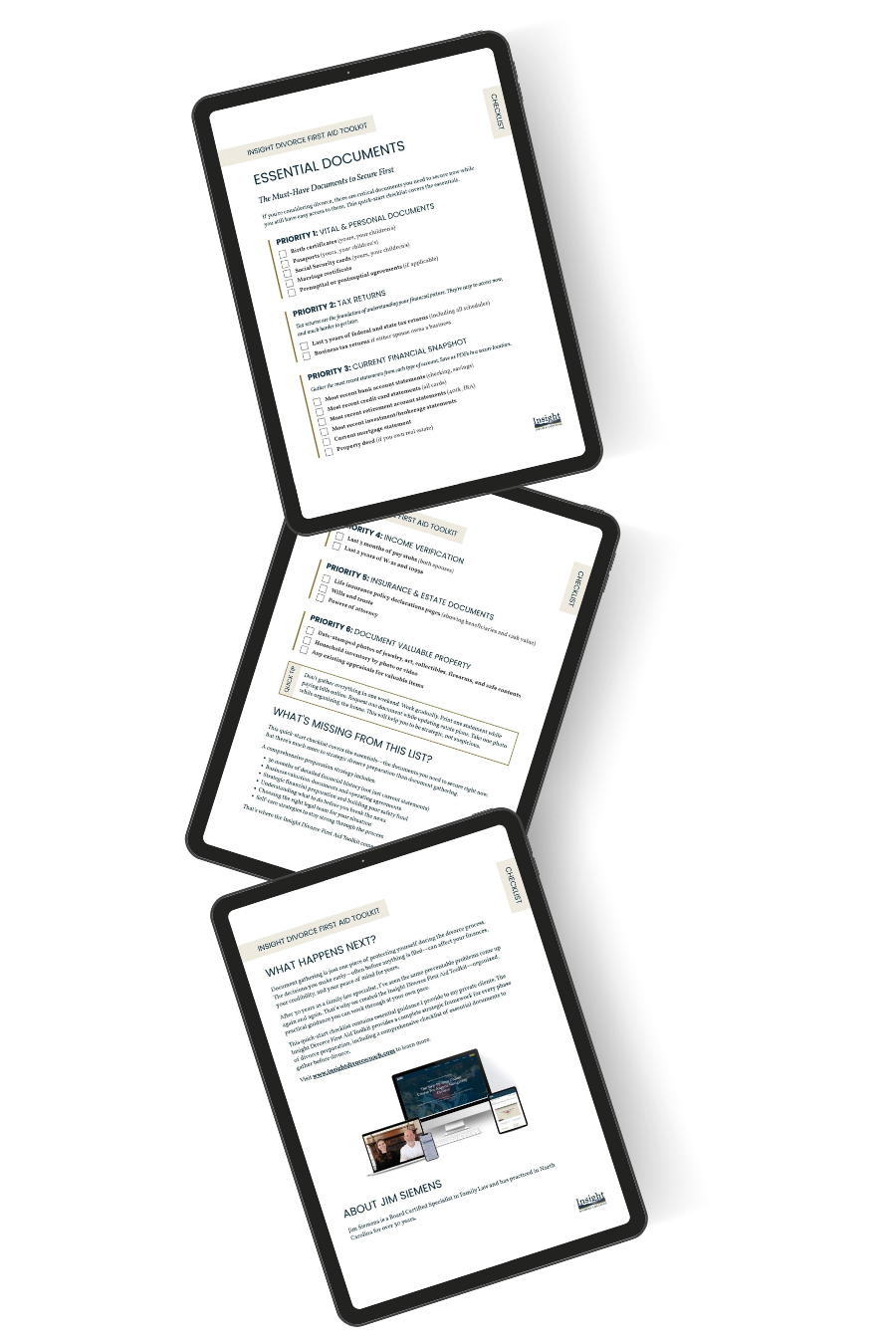
This divorce document checklist covers what to gather, why each category matters, and how to access it, including documents that are easy to overlook until it’s too late.
And if you want a downloadable version of this checklist, we’ll send it to you for free. Click here to download now.
Why Document Gathering Matters So Much in Divorce Preparation
Divorce is, at its core, a financial transaction. A marriage is an economic partnership, and when that partnership ends, property gets divided, income streams are evaluated, and retirement accounts are split. The financial decisions made during this process will affect you for decades, and the quality of those decisions depends entirely on the quality of the information you bring to the table.
This is especially true if you’re over 50. Later-in-life divorces carry a particular kind of financial weight: there’s less time to recover from a bad settlement, retirement assets accumulated over decades are on the table, and Social Security benefits may be affected. The stakes are high, and missing documentation can mean missing out on what you’re legitimately owed.
Before we begin, I want to encourage you to work gradually if you can. Don’t gather everything in one frantic weekend. Print one statement while you’re paying bills online. Request a document while you’re updating estate plans. Be strategic, not suspicious.
Priority 1: Vital and Personal Documents
These are the foundational documents that establish identity and legal status. They’re easy to secure now and can be surprisingly hard to obtain later.
BIRTH CERTIFICATES, PASSPORTS, & SOCIAL SECURITY CARDS
Why it matters: These documents establish your legal identity and are required throughout the divorce process. Secure both yours and your children’s.
How to access: Locate originals and store them in a safe deposit box in your name only, or in a secure location your spouse cannot access. Certified copies of birth certificates can be ordered from your state’s vital records office if originals are unavailable.
MARRIAGE CERTIFICATE
Why it matters: This document is required to file for divorce in most jurisdictions.
How to access: Check your files at home. If you can’t locate it, contact the county clerk’s office in the jurisdiction where you were married.
PRENUPTIAL OR POSTNUPTIAL AGREEMENTS
Why it matters: You may not have these, and that’s okay. If you do have either, it will likely govern significant portions of your settlement. You need to know exactly what you agreed to.
How to access: Check your personal files, safe deposit box, or contact the attorney who drafted it. Your spouse is entitled to a copy as well, but you want your own.
Priority 2: Tax Returns
Tax returns are the foundation of understanding your financial picture. They’re easy to access now, and considerably harder to obtain once a divorce is contested.
LAST 3 YEARS OF FEDERAL & STATE TAX RETURNS (all schedules)
Why it matters: Returns reveal total household income, business income, investment gains, and deductions. They’re the baseline document attorneys and courts use to evaluate financial claims. Three years provide a pattern, while only one year can be misleading.
How to access: Download directly from the IRS website via your IRS online account at irs.gov. You can access transcripts for the last seven years at no cost. If you filed jointly, you have full legal access to those returns.
BUSINESS TAX RETURNS (if either spouse owns a business)
Why it matters: Business income is often structured in ways that make personal income appear lower than it actually is. Business returns, along with K-1s and Schedule C filings, can reveal the true picture.
How to access: If you’re an owner or partner, you have legal access to business returns. Request copies from your accountant or download from the IRS.
Priority 3: Current Financial Snapshot
Gather the most recent statement from each type of account and save them as PDFs in a secure location your spouse cannot access. A cloud account in your name only, where only you have access (Google Drive, iCloud, Dropbox), works well.
BANK ACCOUNT STATEMENTS (checking and savings)
Why it matters: Establishes the current balances in joint and individual accounts and creates a baseline. Courts will look at account history to determine marital assets.
How to access: Log in to your online banking and download the most recent statement as a PDF. While you have access, consider downloading 12 to 24 months of history.
RETIREMENT ACCOUNT STATEMENTS (401k, IRA, pension)
Why it matters: Retirement accounts are frequently the largest marital asset in later-life divorces, and they’re also among the most complicated to divide. A Qualified Domestic Relations Order (QDRO) is required to split most retirement plans, and getting that process wrong has long-term financial consequences. Know what’s there before anyone else frames the picture for you.
How to access: Log in to each plan’s website (Fidelity, Vanguard, your employer portal) and download the most recent quarterly statement. Note both the current balance and the vesting schedule.
INVESTMENT AND BROKERAGE STATEMENTS
Why it matters: Investment accounts outside of retirement plans are often marital assets subject to division. You need current values and the cost basis of holdings to understand what’s actually there after taxes.
How to access: Log in directly to the brokerage accounts (Schwab, Merrill, Edward Jones, etc.) and download current statements.
MORTGAGE STATEMENT & PROPERTY DEED
Why it matters: Your home is likely one of the most significant assets in the marriage. The mortgage statement shows the current balance and payoff amount; the deed shows how the title is held, which matters greatly for division.
How to access: Mortgage statements come monthly. Save a PDF from your online account. Property deeds are public record; your county recorder’s office can provide a copy, or you may find yours in your home files.
Priority 4: Income Documentation
Income documentation establishes what each spouse earns, and what either might be entitled to in the form of support.
LAST 3 MONTHS OF PAY STUBS (both spouses, if accessible)
Why it matters: Pay stubs show gross income, deductions, and benefits. This is a more current picture than tax returns, and is especially important if income has changed recently.
How to access: Download from your employer’s payroll portal. If your spouse’s pay stubs are accessible through a shared account, save copies now.
LAST 2 YEARS OF W-2s AND 1099s
Why it matters: W-2s verify employment income; 1099s capture freelance, consulting, or investment income that might not otherwise be visible.
How to access: These are included with your tax returns. You can also download them directly from the IRS online account portal.
Priority 5: Insurance and Estate Documents
These documents are easy to overlook and can have significant financial consequences if left unaddressed.
LIFE INSURANCE DECLARATIONS PAGES
Why it matters: Life insurance policies show beneficiary designations (which may need to change) and, for whole or universal life policies, accumulated cash value that may be considered a marital asset.
How to access: Contact your insurance company directly or log in to their website. The declarations page summarizes policy details, coverage, and beneficiaries.
WILLS, TRUSTS, AND POWERS OF ATTORNEY
Why it matters: Estate documents will need to be revised as part of the divorce process. Know what’s currently in place. Power of attorney designations are particularly important. Your spouse may currently have legal authority to act on your behalf in ways you’d want to change.
How to access: Contact the estate planning attorney who drafted them, or locate originals in your home files or safe deposit box.
Priority 6: Documentation of Valuable Property
Tangible property, like jewelry, art, collectibles, vehicles, and firearms, can be subject to dispute during divorce, and it’s far easier to document it before the process begins.
Why it matters: Without documentation, valuable property can disappear during the divorce process, or its value can be understated. A contemporaneous record establishes what existed and when.
How to access: Walk through your home with your phone and take date-stamped photos or video of valuables. Include the contents of any safes. Gather any existing appraisals for jewelry, art, or collectibles. Store everything in your secure cloud account.
What This Checklist Doesn’t Cover
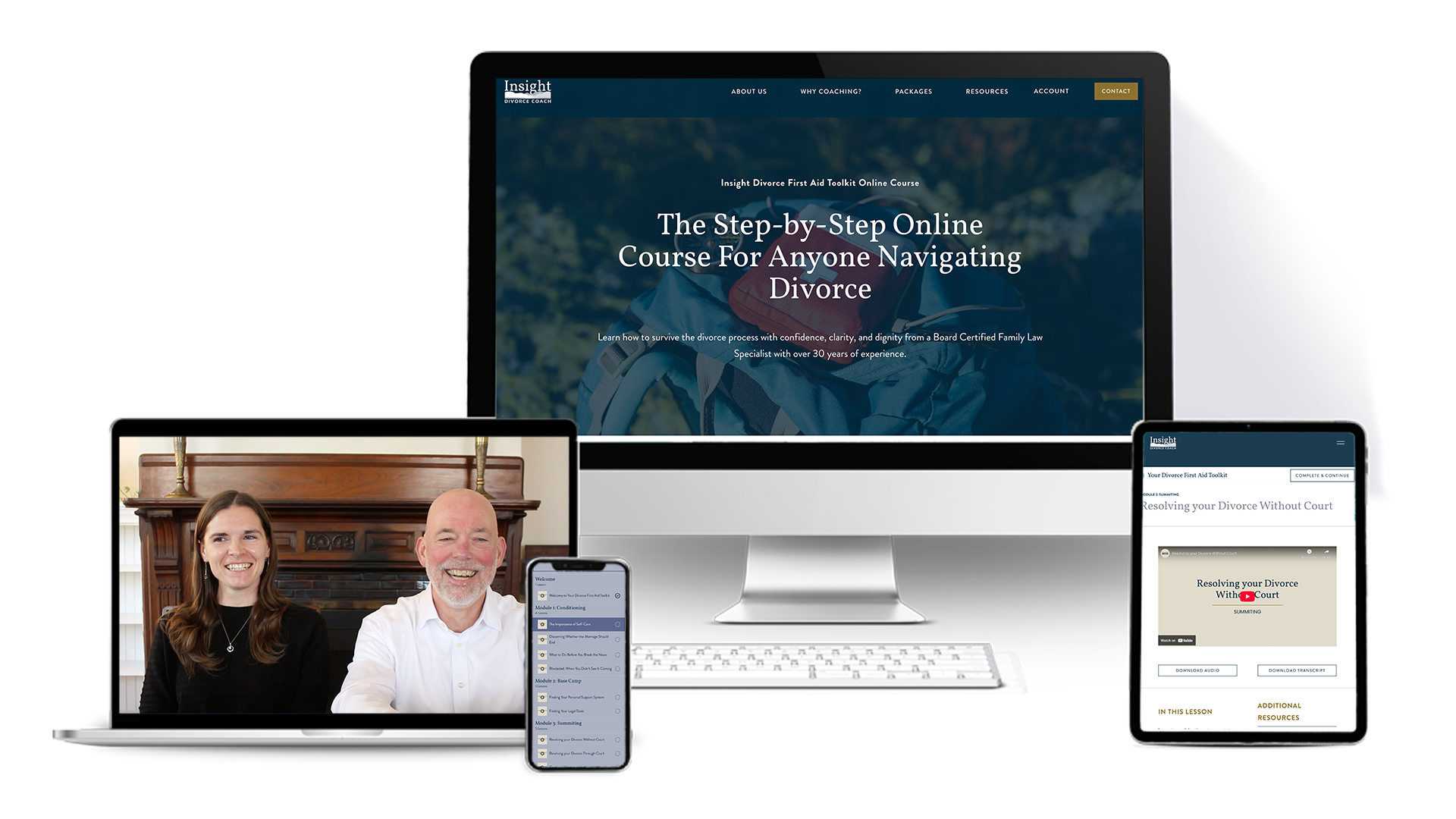
This divorce document checklist covers the essentials of what you need to secure right now, while access is easy. But document gathering is one piece of a much larger preparation strategy.
A comprehensive approach to divorce preparation also includes 36 months of detailed financial history (not just the most recent statements), business valuation documents if either spouse owns a business, a financial safety fund to sustain you through a process that may take longer than expected, and a clear strategy for when and how to break the news. It includes understanding how to find the right legal team for your specific situation and how to take care of yourself through a process that can be mentally and physically demanding.
I’ve spent 30 years watching people navigate this process. The ones who fare best are the ones who prepared quietly, thoughtfully, and completely before the process became public.
Out of a desire to help people prepare without wasting time, energy, or money, I created the Insight Divorce First Aid Toolkit. It provides a complete, step-by-step framework for every phase of divorce preparation and is built on 30 years of real family law experience. It’s designed to help you move forward at your own pace with clarity, confidence, and dignity.
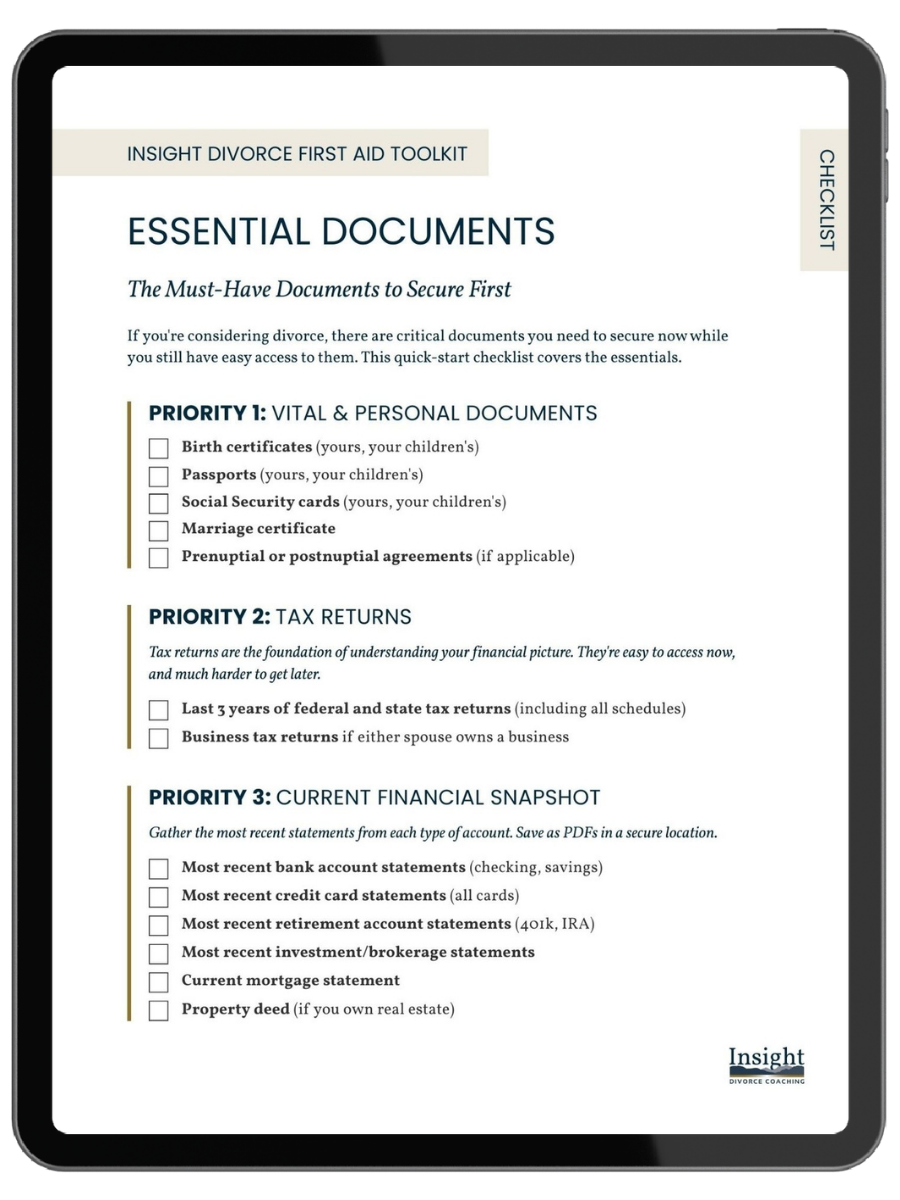
Download Our Free Essential Documents Checklist
The Essential Documents Checklist is a free, printable PDF that walks you through every document category covered in this post—organized by priority, with space to track what you’ve gathered.
It’s the same resource I give to my private clients at the start of the preparation process.

About Jim Siemens
Jim Siemens is an N.C. Board Certified Family Law Specialist with 30 years of practice in Asheville, NC. He founded Insight Divorce Coach to give people the knowledge, tools, and preparation they need to navigate divorce with clarity and confidence before, during, and after the legal process.