
The 4 Critical Steps to Take Before You Tell Your Spouse You Want a Divorce
By Jim Siemens | N.C. Board Certified Family Law Specialist
If you've reached the point where you know your marriage needs to end, the most important thing you can do right now is nothing. At least, not yet.
Before you have that conversation with your spouse, before you say those words out loud, you have a window of time to privately prepare for what comes next. What you do in this window could determine how protected you are financially, how prepared you are legally, how stable you are emotionally, and whether you move through this process from a position of strength or scramble to catch up.
This window is where you do the private preparation, and it matters more than most people realize.
After 30 years as a Board Certified Family Law Specialist, I've watched people walk into the hardest chapter of their lives with varying levels of readiness. Those who fared best, regardless of the complexity of their situation, took deliberate steps before they broke the news. They had a good idea of their assets, they had a better understanding of the law, and they had a plan.
I’m sharing with you the same framework I walk clients through in my own practice. It’s four simple steps that can be done thoughtfully in that precious window of time.
Step 1: Take Care of Yourself First
I know this might not sound like a legal strategy. But in 30 years of practice, I've come to know that self-care is the foundation on which everything else rests, and it belongs at the top of this list.
The reality is you can't predict how a divorce will unfold. It may be amicable. It may not be. A high-conflict divorce can be brutal mentally, emotionally, and physically. This process might take weeks. It might take years. You will face several triggering moments and will need to navigate highly complex situations. Being able to stay clear-headed, rational, and logical will serve you more throughout the process and could mean the difference between a favorable outcome and an unfavorable one.
The people who navigate divorce well are the ones who show up consistently as their best selves over a long period of time. That requires intentional preparation and continuous maintenance.
HOW TO PRACTICE SELF-CARE DURING DIVORCE
Start paying close attention to the basics: diet, rest, and exercise. These aren't indulgences, they're the infrastructure for good decision-making. When you're depleted, you're reactive. When you're rested and grounded, you can be responsive. That distinction can change the outcome of conversations, negotiations, and court proceedings.
If you haven't explored mindfulness practices like meditation, yoga, or mindful breathing, now is a great time to start. You’re not doing these things because divorce is a spiritual journey, though it could become one; you’re doing this because the ability to stay calm under pressure is a genuine competitive advantage in a divorce process. Those who manage their emotional responses well tend to make better decisions and spend less money doing it.
Build your support network. Think carefully about who you want in your corner as you move through this life change: a therapist, a trusted friend, a divorce coach. You need people who can hear you without judgment and help you stay anchored. We cover this in detail in the Insight Divorce First Aid Toolkit, an online course designed to help you navigate the divorce process with confidence, clarity, and dignity. In the second module of the course, we deep dive into how to build a personal support system that actually helps and what to watch out for when your network does more harm than good.
The bottom line is that you do not have to do this alone, and you shouldn't try to.
Prepare yourself the way you would for a challenging journey. Think about the essentials you need, who you want with you, and how you want to show up through the hard parts.
We highly recommend that you come back to self-care throughout this process. It's not a box to check once. It's an ongoing practice that will carry you through this chapter of life, and all the rest to come.
Step 2: Gather Your Financial Information
This step is urgent, and for one important reason: while you are still living under the same roof as your spouse, you have access.
Once the news is out, that access may disappear or come with a lot more hoops to jump through. Accounts get transferred. Paperwork gets moved. Cash that was in a safe is gone. I have seen every one of these things happen. Once you've announced your intention to divorce, gathering financial information tends to become dramatically harder.
So do it now, while you can, carefully and lawfully.
KNOW WHAT’S ON THE TABLE
If you've been the primary financial manager in your household, you may already have a reasonably clear picture. If you haven't, if your spouse has handled the finances and you've operated somewhat in the dark, this is where you need to start.
Run the credit report, look at all joint accounts, gather credit card and bank statements, secure bank accounts, retirement funds, investment accounts, mortgage(s), and auto loans. Most financial institutions now provide electronic statements going back thirty-six months. Download and save everything you can in a secure place that your spouse can’t access.
The goal is to understand the full financial landscape of your marriage: what was earned, what was acquired, what is owed, and what it costs to run your household each month. That information will be central to every financial conversation you have in this process.
KEY DOCUMENTS TO SECURE BEFORE DIVORCE
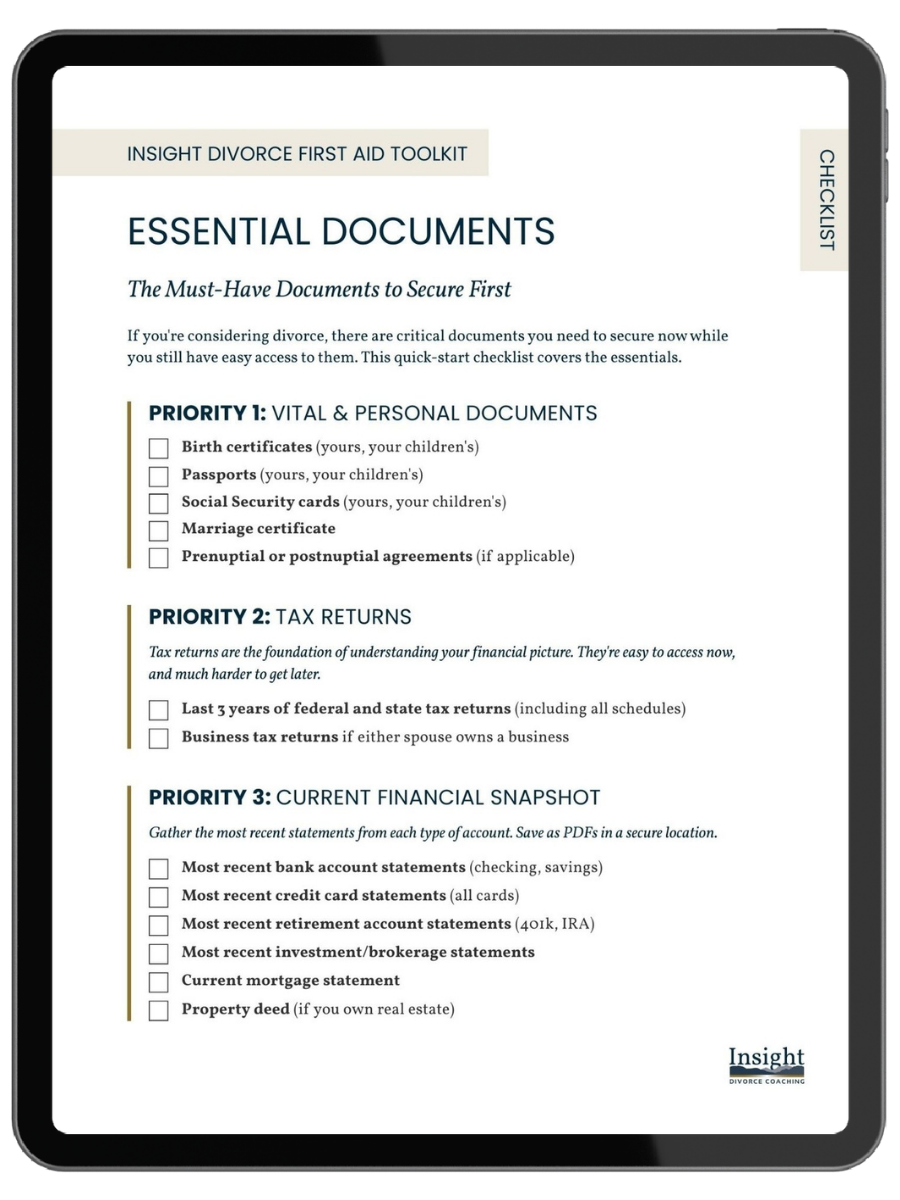
Beyond monthly statements, there are specific documents you want to locate and protect:
Premarital and postmarital agreements
Estate planning documents — wills, trusts, powers of attorney
Tax returns from the past several years
Deeds, titles, and property records
Life insurance policies
Business ownership records, if applicable
Vital documents: birth certificates, passports, Social Security cards, marriage certificate
Store everything as PDF files in a location your spouse cannot access. A secure cloud folder, a thumb drive kept elsewhere, or a safe deposit box — the method matters less than the security.
We’ve created an in-depth checklist of all the essential documents you should gather while you still have access. You can download that checklist for free here.
THINK ABOUT YOUR FINANCIAL RUNWAY
If you are financially dependent on your spouse, this is the moment to be honest with yourself about what you need to bridge the gap between announcement and legal resolution. Legal proceedings take time. Even with the best legal team and a cooperative spouse, it will likely be months before any court-ordered support is in place.
Work toward building a fund that can support you for at least six months. Think carefully about ways you can strengthen your earning capacity before breaking the news. In my jurisdiction, courts tend to reward self-reliance and take a dim view of deliberate financial dependence. The more you can do to establish yourself financially before this process begins, the better positioned you will be throughout it.
Document your household expenses. If you've never tracked your monthly spending, start now. Credit card statements, mortgage or rent, utilities, insurance, groceries, pull it together. If support becomes a contested issue, you'll need to demonstrate what your actual needs are and what the standard of living looked like during the marriage.
Step 3: Consult a Qualified Divorce Attorney
Before you break the news, speak with a qualified divorce lawyer in your state, and ideally, in your specific community.
I want to be clear about what this step is and isn't. Consulting a lawyer before announcing your intention to divorce is not about declaring war. It's not about hiding the ball or getting a tactical edge. It's about understanding the rules of the game before you start playing.
Divorce law varies significantly from state to state, and even within a state, the ways the law is actually applied can vary considerably from one judicial community to another. Courts have cultures, judges have tendencies, and a good local attorney will help you understand not just what the law says, but how it plays out where you live.
WHAT TO EXPECT FROM A CONSULTATION WITH A DIVORCE LAWYER
A qualified attorney in your jurisdiction should be able to help you understand:
The specific laws governing property division in your state, whether you're in an equitable distribution state or a community property state, and what that means for what's subject to division
How alimony or spousal support is determined in your state, including whether there are guidelines or whether it's more discretionary
How the law is likely to apply in your particular situation, given your income, the length of your marriage, and other relevant factors
What rights you have regarding the marital home, and the implications of leaving versus staying
Any jurisdiction-specific issues (like domestic trespass laws) that could affect your logistical planning
Even if your situation seems straightforward, an early consultation is worth it. The questions you don't know to ask are often the most important ones.
Finding the right divorce attorney can feel daunting, which is why we explore this topic in-depth in the Insight Divorce First Aid Toolkit. We give you the questions to ask, the framework to find the right fit, and the confidence to walk away from the wrong one.
A NOTE ON STRATEGY AND SELF-RELIANCE
One question I am frequently asked is something along the lines of, “Should I decrease my income or appear more financially dependent before filing, to improve my odds of receiving alimony?”
My answer is always the same: no.
Stay above the line. Courts are not blind to bad faith suppression of income, and judges are not sympathetic to it. More importantly, making yourself smaller financially (reducing your earning capacity and manufacturing dependence) isn't a strategy. It's a gamble with your own future.
In fact, I recommend you do the opposite. If there's a way to improve your earning capacity, establish an independent income, or secure health insurance coverage before this begins, do it. Preparing yourself in this way gives you strength that will serve you well.
Step 4: Make a Logistical Plan
Before you break the news, you need a plan for what happens next. Not a just a general idea, you need an actual plan.
The announcement of divorce changes things immediately. Who stays in the house, who leaves, what you take with you, where you go; these are not decisions you want to be making under pressure, in the moment, without having thought them through.
HOUSING
If you're considering leaving the marital home, think carefully about this before you go. In many states, including North Carolina, where I practice, once you leave the marital home and your spouse asks you not to return, your right to re-enter is not automatic, even if your name is on the deed, even if it's been your home for decades. Coming back without a court order could put you at risk of arrest for domestic trespass.
That means what you take when you leave matters: clothes, important documents, medications, irreplaceable sentimental items, etc. Think through it in advance, because you may not get a second chance.
Find housing that is appropriate for your actual needs and realistic budget. You don’t want something that is too extravagant because courts pay attention to lifestyle choices during a divorce. But don’t be too minimal either, especially if you'll have children visiting. I've seen people go into what I'd call monk mode: taking a couch in a friend's basement to demonstrate sacrifice. It tends to backfire. It limits your ability to parent, and it doesn't tend to earn you any credit in court.
On the question of the marital home: if you want to stay and can realistically afford to, it may be worth exploring whether you can assume the mortgage independently. Many lenders are now open to mortgage assumption by one spouse. Before you break the news, it's worth a conversation with your lender to understand your options, especially if you're sitting on a low-rate loan you'd like to preserve.
PRIVACY AND DIGITAL SECURITY DURING DIVORCE
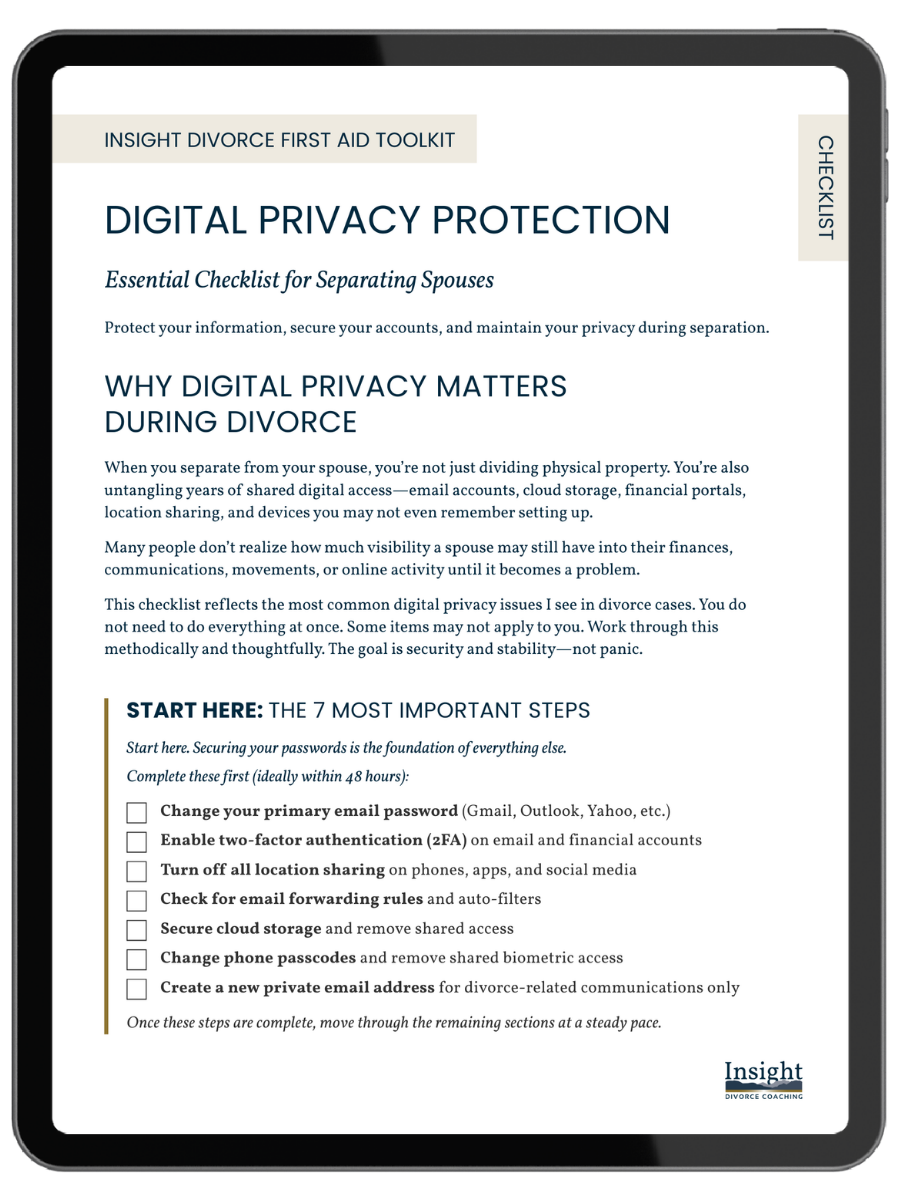
This is an area that deserves more attention than most people give it. We live in a digital world, and divorce proceedings increasingly turn on digital evidence.
Before you break the news, take stock of your digital footprint and what your spouse may have access to:
Change passwords on email accounts, financial accounts, and any accounts that contain sensitive information
Review shared cloud accounts: photos, documents, calendars. If your messages sync to a shared device, address that
Check location tracking on your phone, your vehicle, and any shared apps. Be aware of what can be seen and by whom
Review home security cameras and systems. Your spouse may retain access to these remotely, even after separation
Audit shared subscriptions and services that may reveal information or carry financial implications
Location data, text messages, browsing history, email threads… these have all played roles in divorce cases I've been part of. Not always as dramatic revelations, but as quiet pieces of a puzzle. Be thoughtful about what exists and who has access to it.
If you love a checklist like us, download our free Digital Privacy Protection checklist, which gives you a breakdown of all the corners of the internet where we recommend you secure your privacy before separating from your spouse.
Reframe Your Divorce Preparation
Hold onto this as you work through these areas of preparation:
This is not about competing with your spouse. It's not about winning. It's about preparing for the rest of your life.
The clients who approach divorce as a competition, who focus on outmaneuvering the other person, tend to spend more, suffer more, and end up with outcomes that don't serve them. The ones who keep their own needs, goals, and future clearly in view do better, even in difficult circumstances.
Making your plan is an act of self-care. Gathering your financial information is an act of self-care. Understanding the law is an act of self-care. Every step in this framework is ultimately about giving yourself the clarity, the resources, and the foundation to move forward with intention.
You deserve to go into this prepared.
Your Next Steps
These four steps are the starting framework, but the specifics of your situation matter enormously. The Insight Divorce First Aid Toolkit walks you through every stage of the divorce process in depth: understanding your legal options, finding the right professional team, protecting your financial interests, and taking care of yourself through all of it.
It was built for people who want to move through this process with clarity and intention, not chaos.
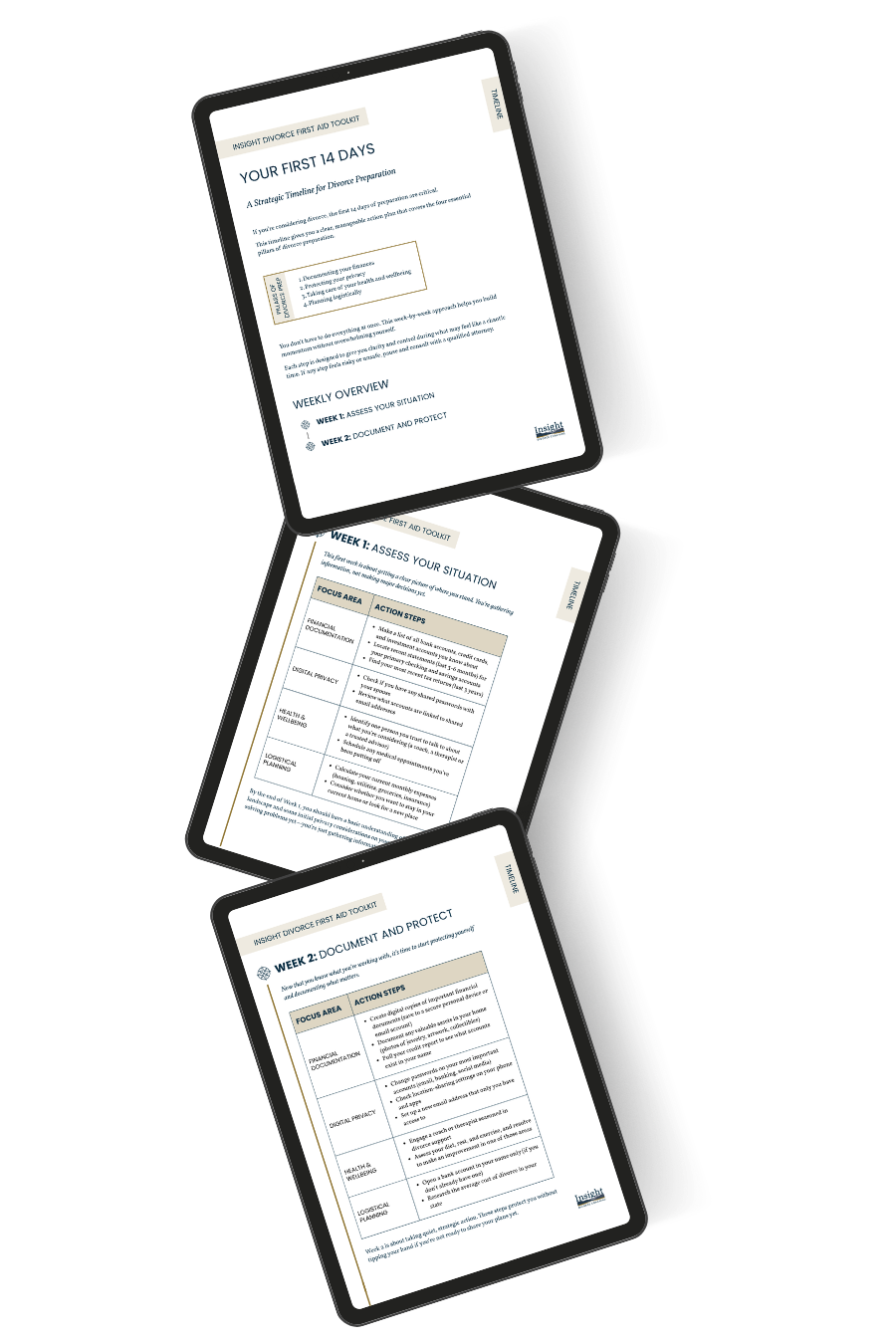
DOWNLOAD THE FREE 14-DAY DIVORCE PREPARATION TIMELINE
Know exactly what to do and when to do it, to prepare strategically for divorce. This is a clear action plan divided into preparation pillars and built from three decades of real divorce cases, showing you exactly what to do in your first two weeks to prepare financially and secure your privacy—all at a manageable pace.
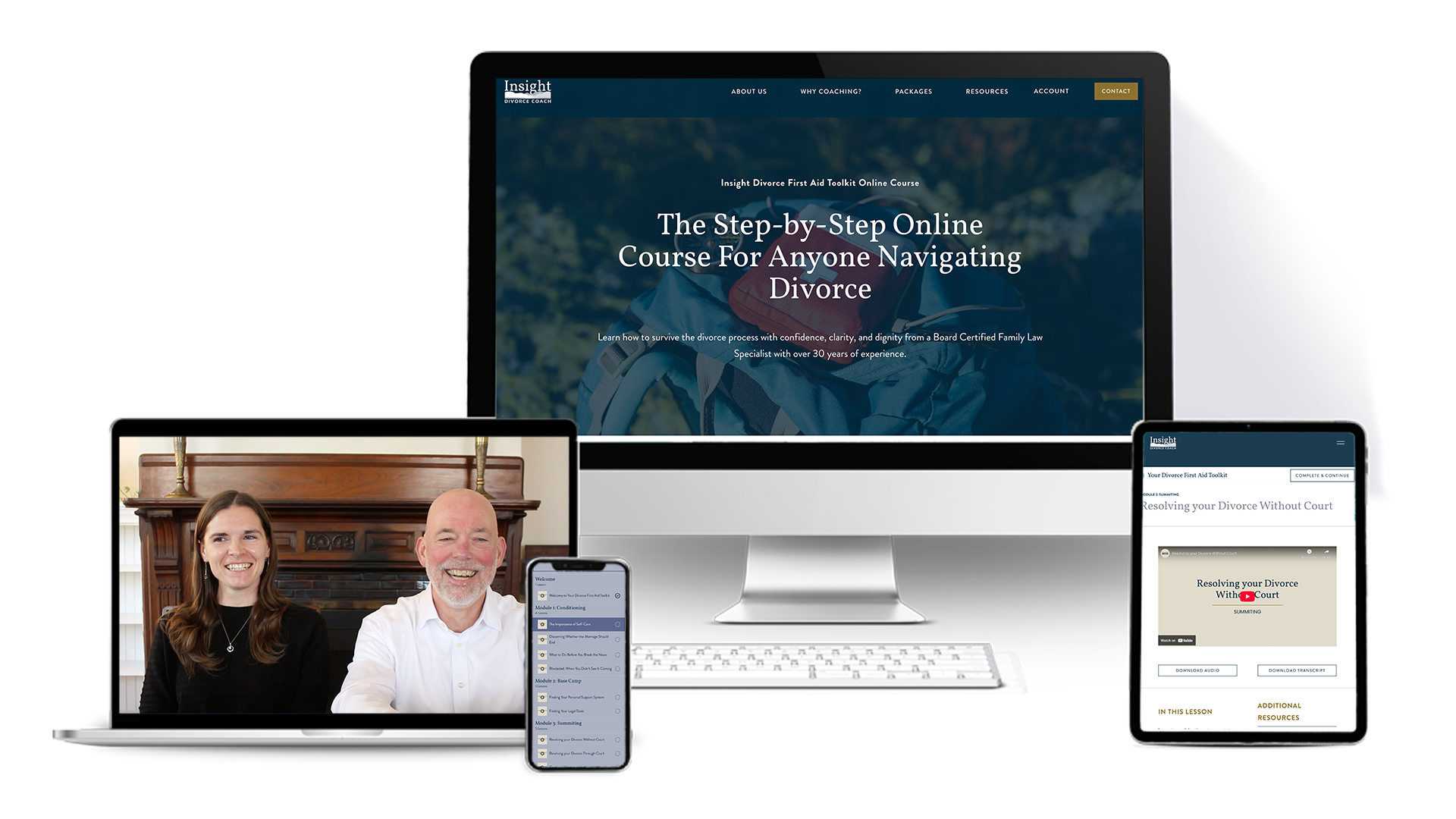
PRIVATELY PREPARE FOR DIVORCE AT YOUR OWN PACE
The Insight Divorce First Aid Toolkit gives you 12 modules of expert guidance — the same framework I use with private coaching clients — at a fraction of the cost of a single legal consultation. Walk through your options, understand what's ahead, and build your plan before you take any public steps.

About Jim Siemens
Jim Siemens is an N.C. Board Certified Family Law Specialist with 30 years of practice in Asheville, NC. He founded Insight Divorce Coach to give people the knowledge, tools, and preparation they need to navigate divorce with clarity and confidence before, during, and after the legal process.