
Take Care of Yourself During Divorce
By Jim Siemens | N.C. Board Certified Family Law Specialist
This is part 4 of a series on mindfulness and decision-making during divorce.
Why Self‑Care Is a Strategic Advantage in Divorce
When you board a plane, flight attendants give a simple instruction: in an emergency, put your oxygen mask on first.
Divorce often feels like an emergency, too. And the same principle applies.
Taking care of yourself during divorce is not indulgent. It is foundational. You cannot think clearly, advocate effectively, or make good decisions if your system is depleted.
DIVORCE EXPOSES WHAT’S ALREADY STRAINED
Divorce places sustained demands on your attention, emotions, finances, and sense of identity. It amplifies whatever is already fragile.
When people are exhausted, undernourished, isolated, or emotionally flooded:
decisions become reactive
communication deteriorates
small problems turn into prolonged conflicts
This is not a character flaw. It is a capacity issue.
RESPONSIBILITY WITHOUT SELF‑BLAME
Divorce is a moment that calls for responsibility for your physical, emotional, mental, and spiritual well‑being.
That responsibility does not mean blaming yourself or pushing through at all costs. It means recognizing that no one else can regulate your nervous system, pace your recovery, or protect your limited bandwidth for you.

WHY THIS MATTERS STRATEGICALLY
People who take care of themselves during divorce tend to:
show up calmer and more credible
articulate their goals more clearly
tolerate uncertainty without panicking
resolve disputes more efficiently
Grounded presence is persuasive. Emotional volatility often works against the very outcomes people say they want.
COMMON TRAPS THAT KEEP PEOPLE STUCK
When self‑care is neglected, people often fall into familiar roles:
the victim
the hero
the martyr
These roles may feel protective in the short term, but they often fuel anger, fear, and shame—and quietly prolong the divorce process.
A GROUNDED STARTING POINT
If you are unsure where to begin, consider asking yourself a few simple questions:
Am I sleeping well enough to think clearly?
Am I eating in a way that stabilizes my energy?
Do I have at least one place where I can speak honestly without judgment?
Do I have support that helps me follow through, not just vent?
These are not luxuries. They are prerequisites for steadiness.
REFRAMING DIVORCE
Divorce is not necessarily a failure. It can be an inflection point for learning, growth, and realignment.
Taking care of yourself is not just about getting through the process. It is about building the foundation for what comes next—and ensuring that the decisions you make along the way reflect who you want to be, not just what you are trying to survive.
Self-Care Starts With Strategy
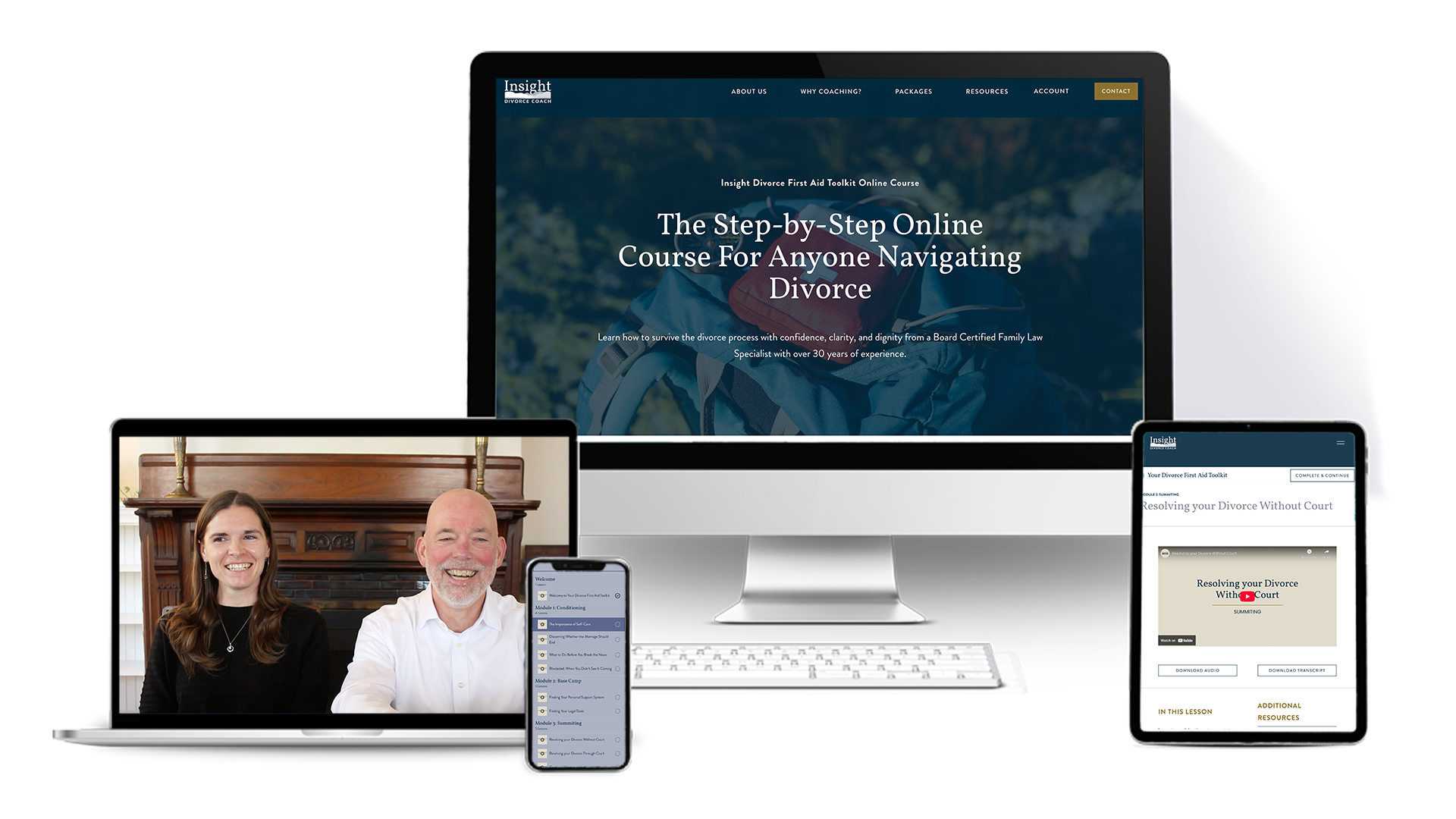
You can't regulate your nervous system, protect your boundaries, or make clear decisions if you don't know what you're protecting or what your next steps should be.
The Insight Divorce First Aid Toolkit removes the uncertainty. This comprehensive course walks you through exactly what you need to secure (documents, accounts, digital privacy) and exactly how to evaluate your options so you're not making decisions from depletion or panic.
You'll learn how to choose the right legal team, understand the full menu of divorce resolution options (from collaborative divorce to mediation to court), and avoid the common mistakes that drain people emotionally and financially. This is the foundation that lets real self-care work.

About Jim Siemens
Jim Siemens is an N.C. Board Certified Family Law Specialist with 30 years of practice in Asheville, NC. He founded Insight Divorce Coach to give people the knowledge, tools, and preparation they need to navigate divorce with clarity and confidence before, during, and after the legal process.